Amazon Quick: AWS Launches Always-On Desktop AI
What Is Amazon Quick, and Why Does It Feel Different?
Amazon Quick is a desktop AI application that runs continuously on your laptop. It connects to your local files, your calendar, your email, and the apps you already use at work. Over time, it builds a personal knowledge graph of your preferences, your contacts, and your projects. Then it surfaces what is relevant before you even think to ask. Quick launched on April 28, 2026 as a standalone desktop app, separate from the enterprise Quick Suite platform that existed before it.
Most AI tools work the same way: you open a chat window, type a question, get an answer, and close the tab. If you forget it exists, nothing happens. Quick is different because it does not wait for you to remember it. It is always running, always paying attention to what you are working on, and ready to tell you what it thinks you should know right now.
That shift sounds small. In practice, it is not.
The Problem With How We Use AI Today
Think about the last time you used an AI assistant. You probably had a specific task in mind: draft this email, summarize this document, explain this error message. You opened the tool, did the thing, closed it. The AI had no idea what you did before or after. It did not know what was on your calendar, or that you had three unread messages from the same client you were writing about.
This is the reactive model. You bring the context, the AI generates the output, and then the session ends. Nothing carries over.
The problem is that the most valuable moments in a workday are rarely the ones where you stop and consciously think "I should ask the AI about this." They are the moments where you are about to miss something, or where two pieces of information sitting in different apps actually connect to each other, and nobody notices. A reactive tool cannot help you with any of that.
Quick's core bet is that the AI should be watching your work, not waiting for you to bring it work.
How the Personal Knowledge Graph Works
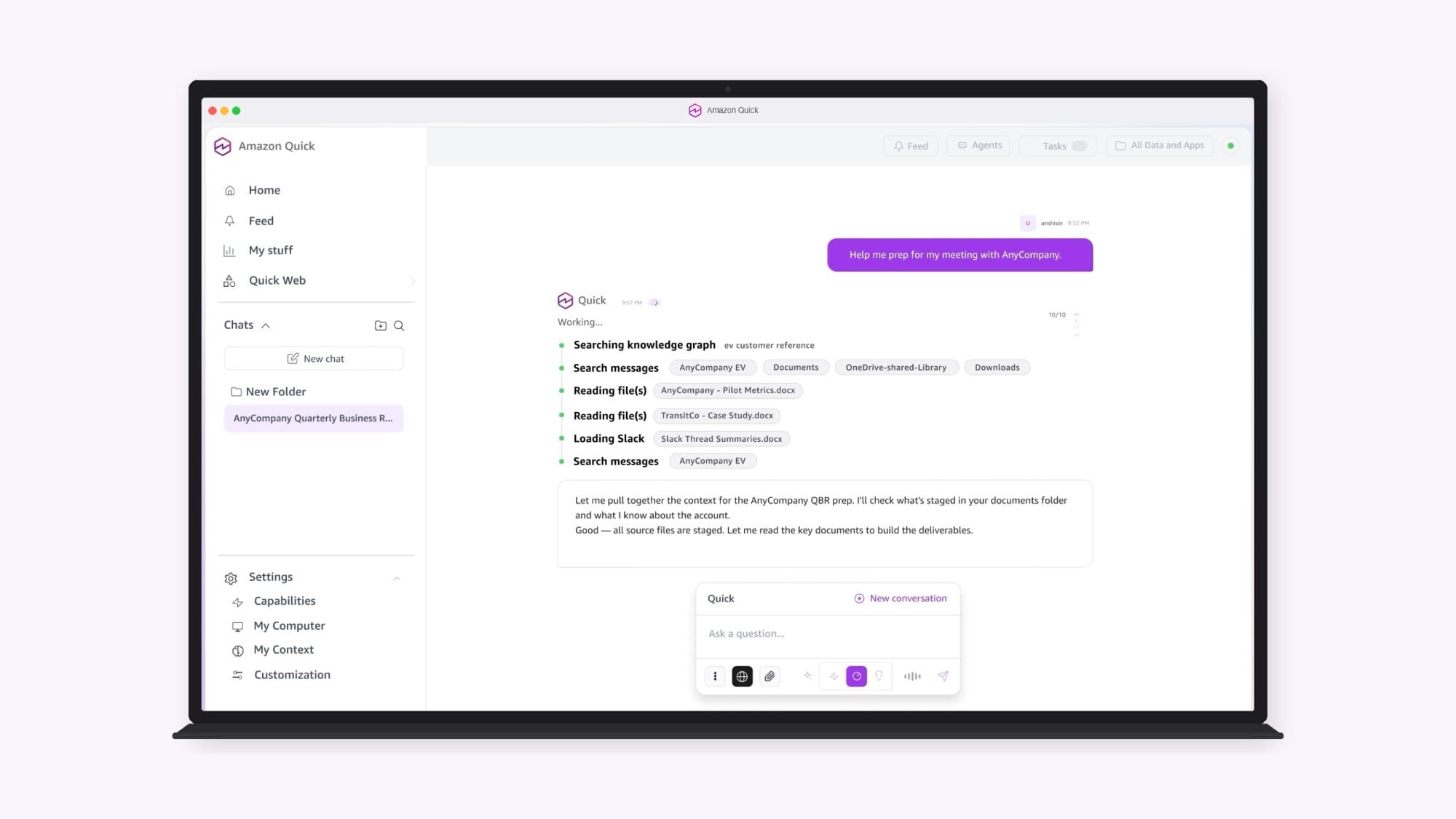
Over time, Quick builds what it calls a personal knowledge graph. This is not just a chat history you can scroll through. It maps your frequent contacts, your active projects, your preferences, and the relationships between all of them. The longer you use it, the more context it holds.
Here is a concrete example. If you have a meeting with a client on your calendar, Quick can surface the last email thread with that client, the documents you both worked on, and the action items you noted after the previous call, all before the meeting starts. You did not search for any of that. Quick connected the dots.
This is what separates it from a smart search bar. It is not just retrieving information on request. It is reasoning about what is relevant to what you are doing right now and putting it in front of you without being asked.
What Actually Launched Today
Today's release is not just a repackaging of existing tools. Amazon added several new capabilities alongside the core product.
Content creation from chat. You can now generate polished documents, presentations, infographics, and images directly inside Quick's chat interface. You describe what you need, Quick produces it. No separate design tool required.
Microsoft 365 extensions. Quick now lives inside Outlook, Word, PowerPoint, and Excel natively. If you are drafting an email in Outlook, Quick already has context about who you are writing to and what your history with them looks like. If you are editing a spreadsheet, it can pull in relevant data from connected sources without you switching tabs.
New integrations. Today's launch adds native connectors for Google Workspace, Zoom, Airtable, Dropbox, and Microsoft Teams. Combined with existing Salesforce and ServiceNow support, Quick now connects to most of the tools that enterprise teams actually use every day.
The framing Amazon is using here is "no walled gardens." Most AI tools embed deeply into one ecosystem. Microsoft Copilot is great if you live in Teams and Office. Google Gemini shines if you live in Workspace. If your team uses a mix of both, plus Salesforce, plus Zoom, you end up with multiple AI assistants that do not know about each other. Quick is positioning itself as the layer that works across all of them from one place.
The Part Nobody Is Talking About: Amazon's Double Partnership
Here is where things get genuinely interesting.
Amazon is doing all three of the following things at the same time.
First, building its own AI models under the Nova brand, trained on its own Trainium chips.
Second, running Quick through Amazon Bedrock, which hosts Anthropic's Claude models. AWS has become the primary cloud infrastructure partner for Anthropic, which means a large share of the compute that runs Claude runs on Amazon's hardware.
Third, hosting OpenAI's models on Bedrock through a Managed Agents partnership, bringing in the very company that Anthropic is racing against.
To understand why this makes sense, you need to understand what Amazon's actual business is.
AWS Is a Compute Business, Not a Model Business
Amazon does not make money by having the best AI model. It makes money by selling the compute that runs AI models. Every GPU hour that Anthropic uses to run Claude and every GPU hour that OpenAI uses to serve its models is revenue for AWS, regardless of which model you personally prefer.
Bedrock functions as a model marketplace. You pick the model, Bedrock runs it, AWS bills the compute. Amazon does not need a strong opinion about which foundation model wins in the long run. Either way, the workload runs on AWS infrastructure, and Amazon collects.
This is a structurally different position from where OpenAI or Anthropic sits. Those companies need you to prefer their specific model. Amazon needs you to stay on AWS. Those are two very different games.
Quick Is Where Amazon Does Pick a Lane
Here is the nuance that makes Quick strategically important. While Bedrock stays neutral across models, Quick is a product with opinions. It is a specific interface, a specific knowledge graph architecture, a specific way of experiencing AI at your desk every morning.
Amazon is not neutral about Quick. They want Quick to be the layer you reach for first. They want it to be the thing you miss when it is gone.
The dual partnership with Anthropic and OpenAI is a hedge on the model layer. Neither of them can leave AWS without a major disruption to their own operations. But Quick is Amazon's bet on owning the experience layer. The infrastructure is the foundation. Quick is the front door.
For a broader look at how AI infrastructure companies position themselves when models become commodities, see The AI Agent Gold Rush: Miners and Shovel Sellers.
The Uncomfortable Question: Do You Want AI Watching Your Screen All Day?
Let me be honest about something.
The always-on pitch is genuinely compelling. But it also describes a piece of software that is continuously reading your files, monitoring your calendar, watching which apps you have open, and building a detailed model of how you work. That is either extremely helpful or quietly unsettling, depending on how you feel about it.
Amazon's response to this concern is a specific privacy promise. Quick never uses your data to train anyone else's model. Your files, your emails, your meeting notes: none of that leaves your personal context to improve a shared model. For enterprise customers who have compliance teams asking exactly this question, that commitment matters a lot.
But there is a difference between "we will not train on your data" and "we cannot see your data." Amazon has access to everything Quick processes. Whether that is acceptable depends on how much you already trust AWS with your cloud workloads. For companies already running on AWS, this may feel like a small extension of an existing relationship. For companies that have kept sensitive data off cloud infrastructure, it is a harder sell.
The Surveillance Anxiety Problem
There is also a softer concern that is harder to articulate but real. When AI is always present, always aware, always ready to comment on what you are doing, some people find that energizing. Others find it genuinely exhausting.
The tools that have spread the fastest in the past decade did so by being useful when you called on them and invisible when you did not. Email is useful. A very attentive colleague watching everything you type and occasionally interrupting with suggestions is different, even if the suggestions are good.
Quick is betting that people will cross that psychological threshold once the utility is obvious enough. That may well be right. But it is worth naming the threshold before you cross it.
What You Give Up When You Pick Quick
No tool is a pure win. Here is what you trade when you commit to Quick.
Gradual lock-in. The personal knowledge graph that makes Quick useful is built inside Quick's architecture. The longer you use it, the harder it is to leave, not because of technical barriers, but because you would be starting over. A year of accumulated context about your clients, your projects, and your working style does not export cleanly anywhere.
Always-on processing overhead. A tool that never turns off never stops using resources. On older machines or devices with smaller batteries, that will show up as degraded performance over a long day. Amazon has not published detailed benchmarks for Quick on lower-end hardware, so real-world performance for most users is still unknown.
Individual versus team knowledge. Quick's knowledge graph is personal. The context it builds is specific to you. If you use it and a colleague does not, your AI-augmented view of a project and their unaugmented view start to diverge. That can create invisible gaps when you need to collaborate or hand something off.
Infrastructure dependency. Quick runs on Bedrock. If AWS has an outage, your always-on AI has an outage too. On-demand tools at least fail quietly when you are not actively using them.
For a look at how teams are thinking through AI tool adoption and its tradeoffs, see my projects section.
What This Looks Like Six Months From Now
Predictions are easy. Let me reason from what is actually observable.
Quick will find its strongest early adopters in enterprise environments where the Salesforce and Microsoft 365 integrations create immediate, measurable value. An enterprise sales rep whose call notes, CRM records, and email threads all live inside one always-on assistant will see the value within days. The knowledge graph does not need months to prove itself if the integrations are already surfacing relevant context at the start of every customer interaction.
The individual freelancer or solo developer is a harder use case. For someone whose "apps" are a GitHub repo and a few browser tabs, Quick's cross-platform value proposition is much weaker. The knowledge graph takes time to become useful, which means early users need patience through the period where Quick is just a capable chat interface and nothing more.
The strategic picture for Amazon is clearer than either of those. Every enterprise that adopts Quick is an enterprise that deepens its AWS footprint. That is not a side effect; it is the point. Quick is a product that Amazon can price aggressively because the real return comes from the Bedrock compute spend underneath it.
The dual partnership with OpenAI and Anthropic means that as Amazon competes with both of them at the product layer through Quick and Nova, it remains the infrastructure that both of them depend on to scale. Amazon's position gets stronger every time either of them grows, regardless of which one wins.
That is a very unusual situation in any industry. It is the most interesting strategic move in AI right now, and it is almost entirely below the surface of the product announcement headlines.
So Is This Worth Your Attention?
Quick desktop is a product that will either feel essential within a month or feel like a permission prompt you eventually revoke. The always-on model is genuinely new. The cross-platform integration is real. The privacy commitment is meaningful if you trust AWS to keep it.
But the bigger story here is not Quick itself. It is what Quick signals about where Amazon is going.
AWS started as the pipes that other people's products ran on. Bedrock positioned it as the model layer those products could choose from. Quick is the step where Amazon shows up at your desk every morning as a product in its own right.
Whether Quick wins the desktop AI race is an open question. Whether AWS wins the infrastructure race underneath it looks like a much safer bet.
Disclaimer: This blog post was researched, written, and published with the assistance of AI. The content reflects general information on the topic and does not represent the personal opinions, beliefs, professional advice, or endorsements of Bhavik Mehta. Nothing in this post should be construed as legal, financial, technical, or professional advice. Readers should independently verify any information before acting on it.